Join Us
Sign up to stay informed of the latest news from Cristianime i Justícia.
In this booklet we will hear the voices of six people who generously offer us their testimony of faith, a faith that has grown strong during lives marked by suffering and resistance, exclusion and encounter, earnest arguments with God and the discovery of God’s infinite love. This booklet is in some ways a continuation of Recognition of LGBTIQ+ Persons in the Church (Booklet CJ #185). It seeks to follow up on what James Martin SJ noted there: “Pastoral outreach to LGBTIQ+ Catholics is not simply a fad or a passing trend, or even something responding to cultural ‘pressures’; rather, it is a constitutive work of the Church and a mission that finds its ultimate roots in the Gospels.”
“Christianity should give a reason for its hope to anybody who asks for it, no matter the historical circumstances or the state of the soul with whomever it faces the future culturally. But in no case can its characteristics, favorable or not to intrahistorical hope, condition the content of the theological virtue of hope, given that it depends exclusively on the Promise of God.” It is about this Christian hope and its reasons that F. J. Vitoria speaks to us in this delicious essay, an essay that can give us a little bit of light in times of uncertainty and darkness.
From a Christian and human perspective, all spiritual searching is something positive, but it requires a special effort of introspection and self-criticism. Some elements of Christian theology are indispensable and cannot be downplayed, since Christian theology must be done from the perspective of “the least and the last” of this world. It is to this debate that the present booklet seeks to make a contribution; it is the fruit of the reflection of a complete course in the theology seminar of Cristianisme i Justícia.
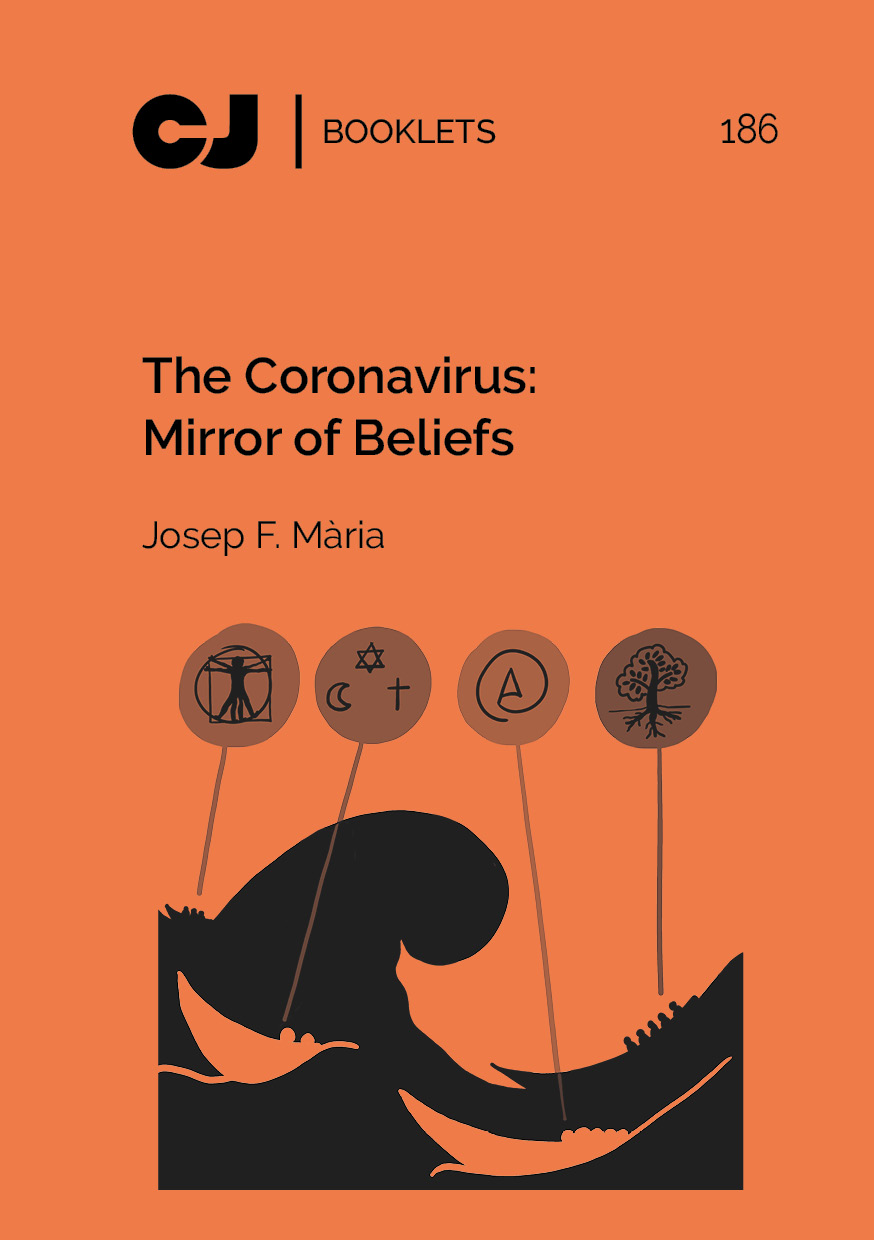
Beliefs become visible —expressing themselves in ideas or actions— when individuals or communities are subjected to events that disrupt their lives. The thesis of this booklet is that the coronavirus has disrupted contemporary Western beliefs and has become a mirror in which these beliefs are reflected. Belief in nature, belief in humanity, belief in God, and simple unbelief have been the diverse reactions that this pandemic has brought to light.
In Europe we are witnessing a genuine collapse of the Christian faith. In relatively few decades, a European society with deep Christian cultural roots has become a society in which Christianity is culturally irrelevant. In this booklet the author analyzes this crisis and then explores the conditions that would make a new Christian initiation possible. Such a re-initiation will have to take place from below, from the poor, from the passion of the people, from the great masses of humankind.
Morning, 9h to 14h
(from monday to friday)
Afternoon, 16h to 19h
(tuesday and thursday)